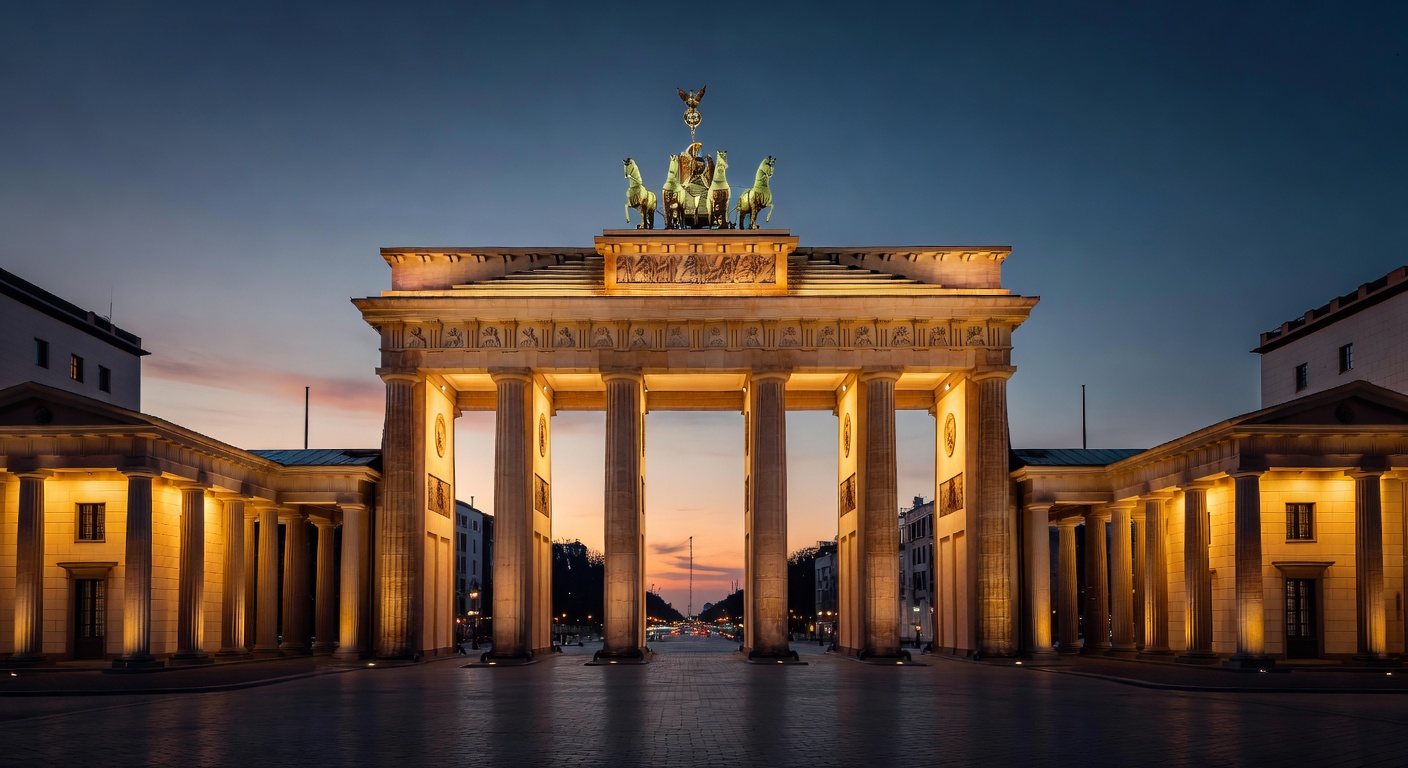
Full Description
The Brandenburg Gate (Brandenburger Tor) is an 18th-century neoclassical monument in Berlin, built on the orders of Prussian king Frederick William II after the temporary restoration of order during the Batavian Revolution. One of the best-known landmarks of Germany, it stands at the western end of the boulevard Unter den Linden, at the junction of Pariser Platz.
Designed by Carl Gotthard Langhans and modeled after the Propylaea gateway on the Acropolis in Athens, the gate was completed in 1791. It features twelve Doric columns forming five passageways and is crowned by the Quadriga — a chariot drawn by four horses driven by Victoria, the Roman goddess of victory.
Throughout its history, the Brandenburg Gate has served as a symbol of division and unity. During the Cold War, it stood in no-man's land between East and West Berlin. When the Berlin Wall fell on November 9, 1989, the gate became the focal point of celebrations and has since represented German reunification and European peace.
History
The gate was commissioned in 1788 and completed in 1791. Originally called the Peace Gate (Friedenstor), it was one of several city gates through which Berlin's customs wall passed. Napoleon marched through the gate in 1806 after his victory at Jena-Auerstedt and took the Quadriga back to Paris as a trophy. It was returned in 1814 after Napoleon's defeat.
During the Nazi era, the gate was used as a party symbol. It suffered significant damage during World War II but was restored. After the construction of the Berlin Wall in 1961, the gate became inaccessible from both sides. Following reunification in 1990, the gate underwent extensive restoration and was reopened on December 22, 2000.
Best Time to Visit
Early morning or late evening provides the best experience. At sunrise, the gate is beautifully illuminated by warm light with virtually no crowds. At night, the gate is spectacularly lit against the dark sky.
December is magical with Christmas markets nearby and festive illumination. New Year's Eve sees Berlin's largest celebration at the gate, with hundreds of thousands gathering for the midnight countdown. October 3 (German Unity Day) features special events and celebrations at Pariser Platz.
Travel Tips
- Free to visit — the Brandenburg Gate is an open-air monument accessible 24/7 at no cost.
- Take the S-Bahn or U-Bahn to Brandenburger Tor station, which brings you directly to the square.
- Visit the Room of Silence — inside one of the gate's side rooms, there's a small meditation room open to all visitors for quiet reflection.
- Be aware of pickpockets — Pariser Platz is heavily touristed. Keep belongings secure.
- Combine with a walking tour — the gate is the natural starting point for exploring Unter den Linden, the Reichstag, Tiergarten, and the Holocaust Memorial.
- Best photo spots — stand directly in front on Pariser Platz for the classic view, or cross to the Tiergarten side for a wider perspective.
Nearby Attractions
- Reichstag Building — the German parliament, with a stunning glass dome offering 360° views of Berlin (free, reservation required).
- Holocaust Memorial (Memorial to the Murdered Jews of Europe) — a powerful and moving field of 2,711 concrete stelae, just a short walk south.
- Tiergarten — Berlin's Central Park, a vast green oasis perfect for walking, cycling, and relaxation.
- Unter den Linden — Berlin's grand boulevard stretching from the gate to Museum Island, lined with historic buildings.
- Potsdamer Platz — a vibrant modern district with shopping, dining, and entertainment, 10 minutes on foot.