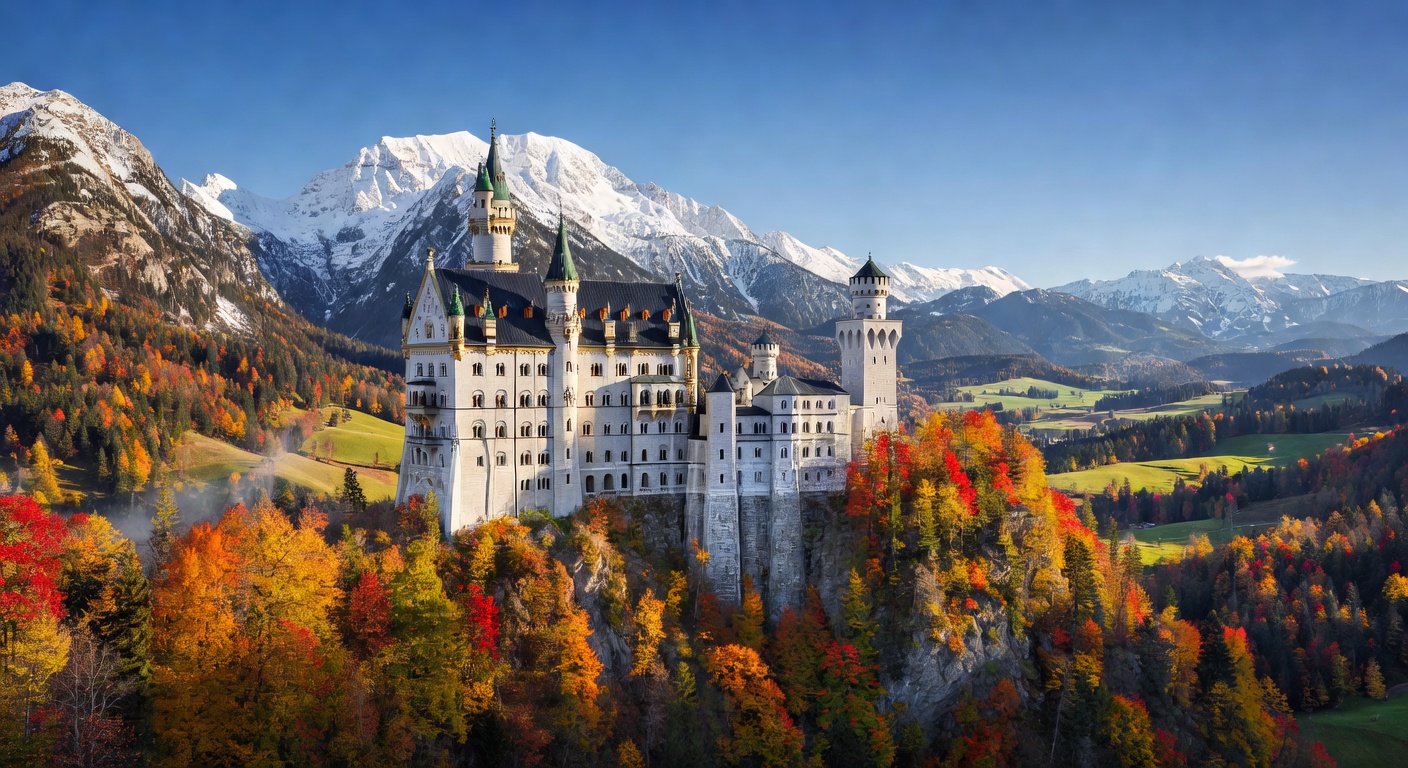
Full Description
Neuschwanstein Castle (Schloss Neuschwanstein) is a 19th-century historicist palace on a rugged hill above the village of Hohenschwangau near Füssen in southwest Bavaria, Germany. The palace was commissioned by King Ludwig II of Bavaria as a retreat and as a homage to Richard Wagner. Ludwig paid for the palace out of his personal fortune and by means of extensive borrowing, rather than Bavarian public funds.
The castle was intended as a personal refuge for the reclusive king, but it was opened to the paying public immediately after his death in 1886. Since then, more than 61 million people have visited Neuschwanstein Castle. More than 1.3 million people visit annually, with as many as 6,000 per day in the summer.
The palatial architecture is a marvel of Romanesque Revival design, featuring ornate turrets, dramatic balconies, and lavishly decorated interior rooms that depict scenes from Wagner's operas. The Singers' Hall, the Throne Room, and the King's bedchamber are among the most spectacular spaces in European palace architecture.
History
The foundation stone was laid on September 5, 1869. The construction was never fully completed — only 14 of the planned rooms were finished before Ludwig's death. The king lived in the castle for only about 172 days total.
King Ludwig II conceived the castle in 1868, writing to Wagner: "I intend to rebuild the old castle ruin of Hohenschwangau near the Pöllat Gorge in the authentic style of the old German knights' castles." The design was primarily the work of stage designer Christian Jank, with architect Eduard Riedel translating Jank's romantic visions into technical plans.
After Ludwig's mysterious death in 1886, the Bavarian government opened the castle to visitors against the deceased king's explicit wishes. Ironically, the castle that Ludwig built to escape public life has become one of the most public buildings in Germany. During World War II, the Nazis used the castle to store art and treasures looted from occupied countries.
Best Time to Visit
September to October is considered the best time to visit Neuschwanstein Castle. The autumn foliage transforms the surrounding forests into a stunning tapestry of gold, orange, and crimson, providing the most photogenic backdrop for the castle.
Summer (June–August) brings the warmest weather and longest days but also the largest crowds, with wait times for tours exceeding two hours. Winter (December–February) offers a magical snow-covered landscape with far fewer tourists, though some viewpoints and the Marienbrücke bridge may be closed due to ice.
Spring (April–May) is excellent for comfortable temperatures and blooming meadows, with moderate crowds and pleasant hiking conditions.
Travel Tips
- Book tickets online in advance — walk-up tickets often sell out, especially in peak season. Reservations can be made through the official Bavarian palace website.
- Arrive early — the ticket center opens at 8:00 AM. Book the earliest tour slot available (usually 9:00 AM) to avoid crowds.
- Wear comfortable walking shoes — the uphill walk from the ticket center to the castle takes about 30–40 minutes on a steep paved road.
- Visit the Marienbrücke (Mary's Bridge) — this footbridge spanning the Pöllat Gorge offers the most iconic view of the castle. It's a 10-minute walk beyond the castle entrance.
- Consider the horse-drawn carriage — carriages run from the village up to the castle for a small fee, saving you the uphill walk.
- Photography is not allowed inside the castle — but exterior and landscape photography is unlimited.
- Budget about 3–4 hours for the complete visit including the walk, tour, and time at viewpoints.
Nearby Attractions
- Hohenschwangau Castle — Ludwig II's childhood residence, located just across the valley. A joint ticket covers both castles.
- Füssen Old Town — a charming Bavarian town with medieval architecture, cafés, and the Hohes Schloss (High Castle).
- Tegelberg Mountain — accessible by cable car, offering stunning Alpine panoramas and paragliding opportunities.
- Forggensee Lake — Bavaria's fifth-largest lake, perfect for boat tours with views of the castle and mountains.
- Wieskirche (Pilgrimage Church of Wies) — a UNESCO World Heritage Site about 25 km away, featuring stunning Rococo architecture.